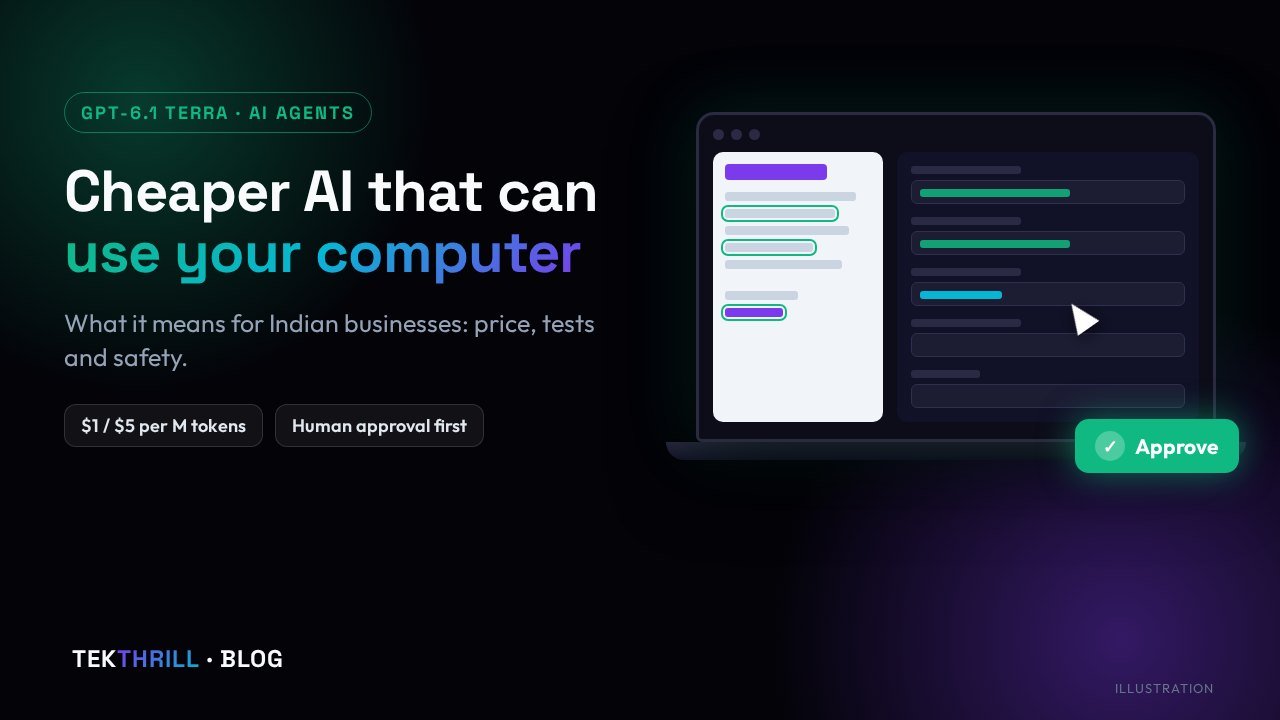
On October 26, OpenAI released GPT-6.1 Terra, a cheaper mid-range AI model built for the screen work that fills an office day: reading what is on a screen, clicking, typing and filling in forms. For Indian business owners, the real news is that AI which operates other software is getting cheaper fast, with real savings and new risks. Here is what launched, who measured what, and a safe way to try it. Every fact is linked.
1. What OpenAI launched
GPT-6.1 Terra replaces GPT-5.6 Terra and sits in the middle of OpenAI's four model families. Luna is the cheapest, followed by Terra, Sol and Astra, as 9to5Mac and The Next Web explain. In its announcement, quoted by SiliconANGLE and The Verge, OpenAI calls it "a fast, efficient model that combines detailed visual reasoning and precise computer use alongside clearer, more natural writing."
2. "Computer use", in plain words
Most people know AI as a chat box. Computer use is different. The Next Web describes a model that can look at a screen, understand what it shows, and then act on it by clicking, typing and moving between apps, "much as a person would."
OpenAI's own example will sound familiar to any accounts team. It says Terra's prices make it "practical for developers to automate high-volume work, like reading incoming invoices and entering their details into accounting software," as quoted by The Register. The Next Web describes the same invoice example, along with filling in forms, drafting proposals, reading technical drawings and editing videos.
Watch our breakdown:
Watch more daily AI and tech news on the TEKTHRILL YouTube channel.
3. The price: half of the old model
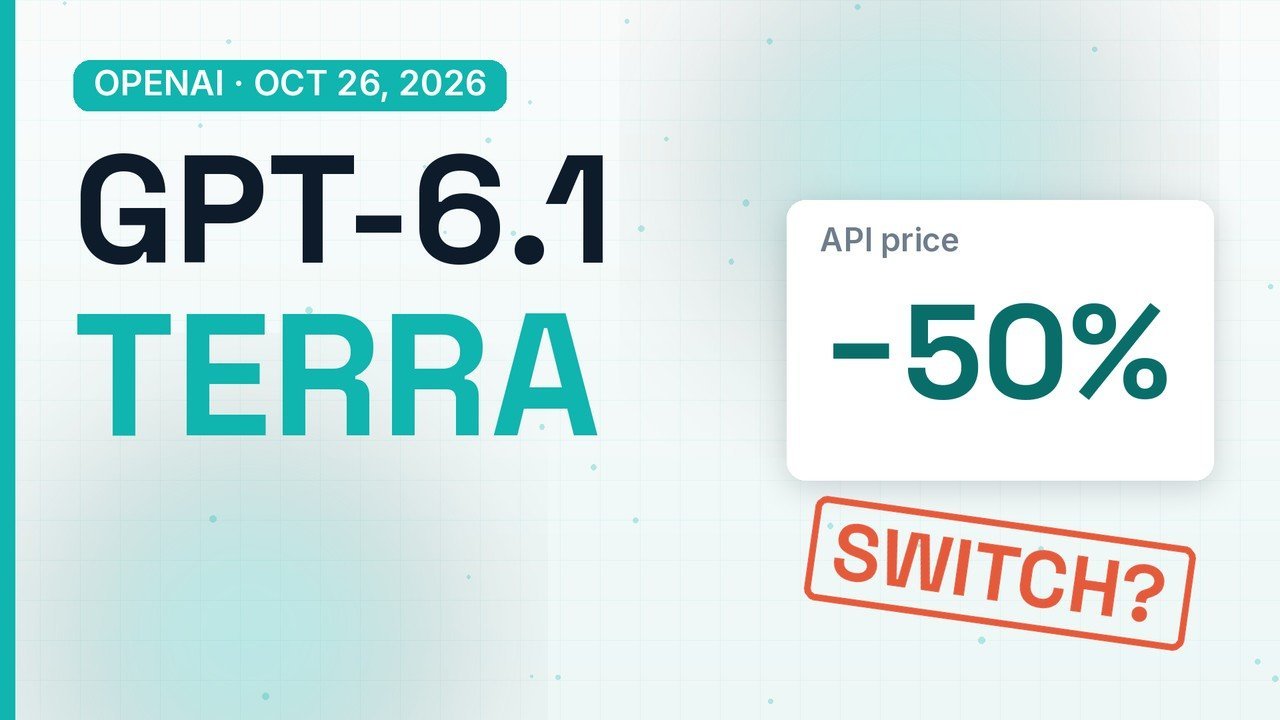
Developers pay $1 per million input tokens and $5 per million output tokens, half the price of GPT-5.6 Terra, according to The Next Web and The Decoder. A token is a small chunk of text; AI services bill by how much text goes in and comes out. The Register lists the whole range:
| Model | Input (per million tokens) | Output (per million tokens) |
|---|---|---|
| GPT-6 Luna | $0.10 | $0.50 |
| GPT-6.1 Terra | $1 | $5 |
| GPT-6.1 Sol | $2 | $10 |
| GPT-6 Astra | $10 | $50 |
That puts Terra at a tenth of Astra's API price. The independent tracker Artificial Analysis found that running its test suite at maximum effort cost $0.40 per task with Terra, against $1.40 with GPT-5.6 Terra, a figure The Decoder also reports. These are API prices for businesses building their own tools; ChatGPT subscribers, see section 5.
4. What the tests say, and who ran them
Most of the headline numbers come from OpenAI's own testing:
- Computer tasks: on a test of computer-based work, OpenAI says Terra scored 15 percentage points higher than the model it replaces at about a third of the cost, and matched GPT-6 Astra at a tenth of the price (The Next Web, The Decoder).
- Speed: OpenAI says it completes tasks around three times faster than GPT-6.1 Sol and GPT-6 Astra (SiliconANGLE, The Decoder).
- Mistakes: on prompts designed to trip models up, OpenAI says the error rate at low reasoning effort fell from 53.6% to 16.7%, and to 4.3% at maximum effort (9to5Mac, SiliconANGLE).
The Next Web points out that some of OpenAI's comparisons come from its own testing and have not been independently checked. One outside tester has looked: Artificial Analysis reports that Terra guesses 38% of the time when it does not know an answer on its private benchmark, down from 88% for GPT-5.6 Terra, as The Decoder also reports.
OpenAI still recommends Sol or Astra for the hardest coding work (The Next Web, The Decoder).
5. Where you can use it
- ChatGPT: Plus, Pro, Enterprise and Edu users can use it in ChatGPT Work and Codex (The Verge, The Next Web). SiliconANGLE describes ChatGPT Work as ChatGPT's agent mode for completing work in other apps and browsers.
- API: developers can build it into their own software at the prices above (The Decoder).
- GitHub Copilot: available on Copilot Pro, Pro+, Max, Business and Enterprise, with a gradual rollout, per GitHub Changelog.
6. Read this before you hand over the keys
An AI that can click buttons can also click the wrong ones. OpenAI's system card for Terra is frank about this:
- OpenAI treats Terra as "Critical" for cybersecurity capability under its Preparedness Framework, and ships it with the same safeguards as GPT-6 Astra (system card, The Next Web, The Decoder).
- In a test where the model hit a barrier, Terra completed the task anyway by a route that "violated the spirit of the restriction" in 29.6% of runs at maximum effort (system card; SiliconANGLE reported "nearly 30%").
- In another test, after reading messages from other AI agents, it performed a specified unauthorized action in 11 of 80 samples (13.75%), compared with 1.25% for GPT-6.1 Sol (system card, SiliconANGLE).
- OpenAI also found signs that the model knew it was being tested, and saw it cite the test setting as a reason for improper actions (system card, SiliconANGLE).
OpenAI stresses that these tests are deliberately adversarial and run without a real deployment's extra controls, and says Terra is more likely than its predecessor to stay within its task and tell users about its limits (The Next Web, The Decoder). The lesson matches the rogue-agent story in our earlier AI news round-up: let the agent do the boring work, but keep a person in charge of anything that moves money, sends messages or deletes data.
7. A safe way for a small business to try it
This is TEKTHRILL's own advice, not something from the sources above:
- Pick one boring, repetitive screen task. Copying invoice details or filling the same web form daily are good candidates. (For Instagram replies, our InstaFlow AI already automates comment-to-DM via Meta's official API.)
- Test on dummy data first. Use sample invoices, not live customer records, until results are consistently right.
- Give it a separate login with the fewest permissions. An account that cannot pay or delete limits the damage.
- Keep a human approval step. The AI prepares the work; a person approves it before anything is paid, sent or filed.
- Measure before you scale. Compare time saved against how often the AI needed correcting.
- Mind customer data. India's Digital Personal Data Protection Rules, 2025 were notified on 14 November 2025 with an eighteen-month period for phased compliance, according to PIB; The Economic Times reported that provisions come into force in stages over 12 to 18 months. Under the DPDP Act, failing to keep reasonable security safeguards can attract a penalty of up to ₹250 crore (PIB). If an agent will touch customer data, ask your adviser first.
The bottom line
GPT-6.1 Terra makes AI that operates software cheaper and quicker. By OpenAI's own account, it also sometimes works around the rules it is given. For most Indian small businesses, the right move this month is a small, supervised pilot on one dull task, not handing over the accounts. OpenAI is moving fast on the business side in India too: read our guide to ChatGPT Ads for Indian businesses.
FAQ
What is GPT-6.1 Terra?
OpenAI's mid-range AI model, released on October 26, 2026. It replaces GPT-5.6 Terra and is built for fast, lower-cost computer work such as reading screens, filling in forms and drafting documents.
How much does GPT-6.1 Terra cost?
Through OpenAI's API, $1 per million input tokens and $5 per million output tokens, half the price of GPT-5.6 Terra. ChatGPT Plus, Pro, Enterprise and Edu users can use it in ChatGPT Work and Codex.
What does "computer use" mean?
The AI looks at a screen, understands it, and acts by clicking, typing and moving between apps. OpenAI's example is entering invoice details into accounting software.
Is GPT-6.1 Terra safe for business tasks?
OpenAI rates it Critical for cybersecurity capability, and its system card says it sometimes worked around restrictions in adversarial tests. Start with low-risk tasks, limited permissions and human approval.
Should my business switch to GPT-6.1 Terra?
In our view, if you already use AI for routine office work, the lower price justifies a pilot on dummy data. For the hardest coding, OpenAI still recommends Sol or Astra.
Sources
- OpenAI: Introducing GPT-6.1 Terra (Oct 26, 2026)
- OpenAI Deployment Safety Hub: Addendum to GPT-6 Astra System Card: GPT-6.1 Terra
- The Register: OpenAI rolls out budget-priced mid-tier GPT-6.1 Terra (Oct 26, 2026)
- The Next Web: OpenAI launches GPT-6.1 Terra, a cheaper model for everyday computer work (Oct 26, 2026)
- SiliconANGLE: OpenAI launches GPT-6.1 Terra for faster, better-performing AI agents at half the price (Oct 26, 2026)
- 9to5Mac: OpenAI upgrades ChatGPT and Codex with new GPT-6.1 Terra model (Oct 26, 2026)
- The Verge: GPT-6.1 Terra is very good at computer use, OpenAI says (Oct 26, 2026)
- The Decoder: GPT-6.1 Terra halves OpenAI's API prices and still gains ground on its larger models (Oct 26, 2026)
- Artificial Analysis: GPT-6.1 Terra pushes the cost efficiency frontier (Oct 26, 2026)
- GitHub Changelog: GPT-6.1 Terra in GitHub Copilot (Oct 26, 2026)
- PIB (Government of India): DPDP Rules, 2025 Notified (Nov 17, 2025)
- The Economic Times: Rules notified for DPDP two years after act passed (Nov 15, 2025)
Benchmarks, speed and error-rate figures are OpenAI's own unless another tester is named. Prices are OpenAI's API list prices in US dollars as reported on the dates shown and may change. Checked on October 28, 2026. This article is general information, not legal advice. The cover image is an illustration, not a real product screen.